


If you work for yourself - as a freelancer, consultant, or independent professional - the rise of AI is not an abstract conversation. It is already changing what clients expect, what they are willing to pay for, and which briefs simply stop coming.
The people who navigate this well are not necessarily the most technically advanced. They are the ones who understand where their judgment is irreplaceable - and deliberately move their work in that direction.
Here is what the data says, and what it means for you.
The work already being automated
Recent research did not ask whether AI could theoretically do a task. It studied what AI is already being used for in real professional settings. The findings surprised many people.
The most exposed roles are not low-wage or low-skill jobs. They are often highly educated, high-paying knowledge roles - exactly where many freelancers earn their living.
- Computer programmers: 74.5% exposure
- Customer service roles: 70.1%
- Data entry: 67.1%
- Financial analysts: 57.2%
If your work involves writing, coding, research, or analysis, you are in a high-exposure segment. That does not mean your career is over. It means your value has to move upward - toward judgment, interpretation, and the kind of trust clients do not extend to a tool.
Why freelancers feel it first
For salaried employees, a role can be partly automated while the rest remains intact. A salary and a team still provide some buffer.
Freelancers do not have that buffer. Every project starts from zero. When a client decides AI can handle part of the work, there is no severance and no redeployment. The brief simply stops coming.
Companies are already using AI to absorb first drafts, routine research, and standard code checks. Freelancers often sit closest to exactly those assignments.
What this means for professionals in India
For Indian tech professionals, the numbers are striking. Research shows AI can complete in under 15 minutes what would otherwise take close to four hours - a roughly 15x speedup, ahead of the global average.
Analysts estimate that 9% to 12% of Indian IT services revenue could be affected within four years. For independent professionals in Hyderabad, Bengaluru, and Chennai, this is not a distant trend. It is already changing what clients expect to pay for.
The one thing the freelancers who thrive have in common
They stopped thinking of themselves as doers and started thinking of themselves as directors.AI can produce a first draft. It cannot tell you whether that draft is right for this client and this moment. AI can generate code. It cannot tell you whether it will hold up in a messy real-world environment six months from now. AI can surface information. It cannot tell you which information matters.
That gap between output and judgment is where the strongest freelance careers are being built right now. Here is where to focus:
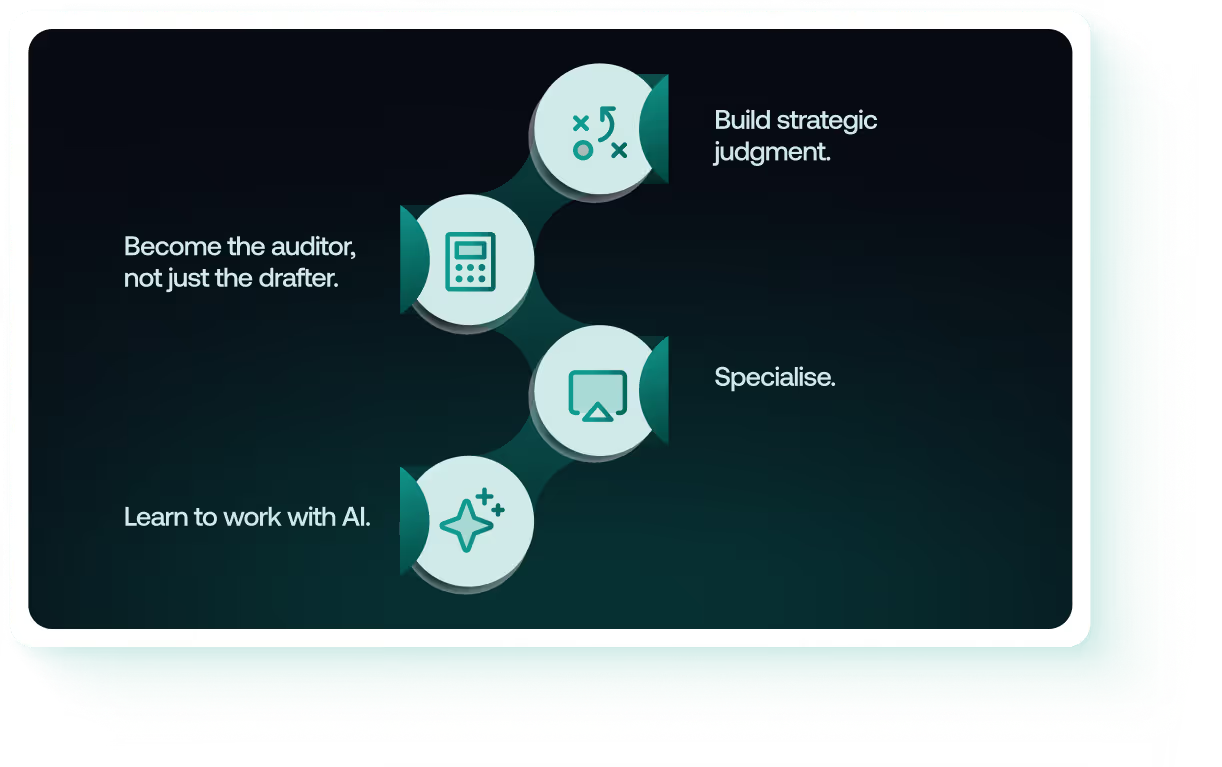
Build strategic judgment. Clients will still pay for someone who can navigate ambiguity and make calls that carry real weight. AI cannot do that reliably.
Become the auditor, not just the drafter. The value now lies in knowing what good looks like and being able to push work toward it.
Specialise. Generalist work is being commoditised fastest. Depth in a specific domain, backed by a track record, is harder to replace.
Learn to work with AI. The ability to direct AI toward a result a client cannot reach alone is becoming a valuable skill in its own right.
The bottom line
The freelance skills that once filled pipelines are being commoditised quickly. But the lane for independent professionals who combine deep expertise, sound judgment, and the ability to direct AI effectively is not disappearing - it is becoming more defensible.
The freelancers who will thrive are not the ones who ignore this shift or panic about it. They are the ones who understand where their judgment is irreplaceable and build their work around that.
The earlier you start moving in that direction, the more ground you cover.