

Most bugs in AI-generated code never crash anything. They sit inside a perfectly reasonable function until the day a customer named O’Brien tries to sign up and is told her email address is invalid. It isn’t. Apostrophes are allowed. The code had just never met anyone called O’Brien.
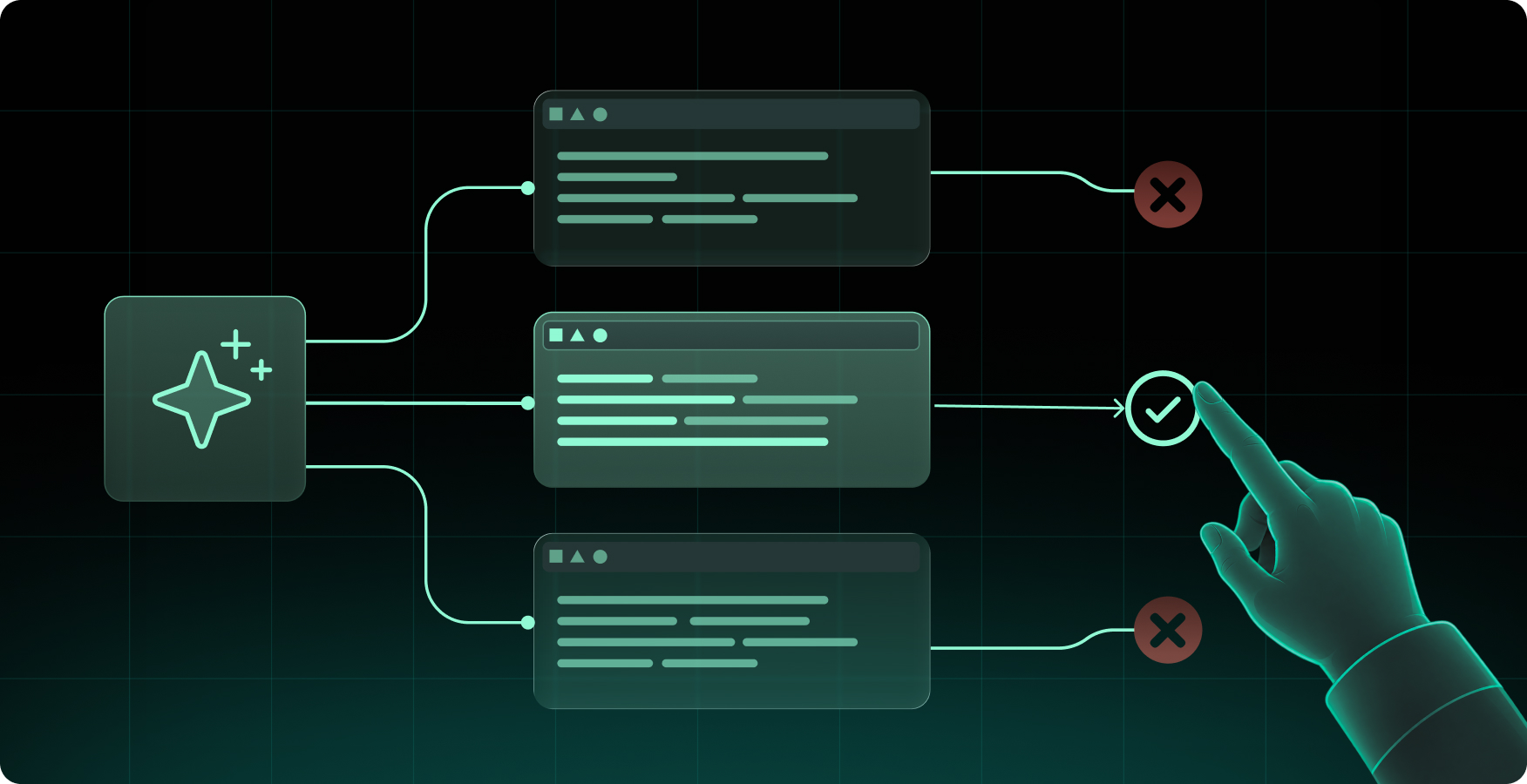
Small, quiet mistakes like that are the real story. Much of what AI coding tools write is genuinely useful, and the problems tend to hide in exactly the places a quick review skims past. Catching them takes a person who knows what the software is meant to do.
Developers have noticed. In Stack Overflow’s 2026 Developer Survey, 66% of respondents said they use coding assistants or agents, and nearly half said they trust AI output when they can easily verify it. In other words, the checking is still their job.
What AI-Generated Code Is and How It Gets Written
Underneath every AI coding tool sits a large language model, a system trained on huge amounts of text and public code that predicts what should come next. Think of your phone keyboard suggesting the next word, with a far bigger vocabulary.
The tools come in two broad types. Assistants suggest code as you type or answer requests in chat. Agents, such as Claude Code and GitHub Copilot, go further, working across the whole repository (the project’s full collection of code) and proposing finished changes for a human to approve.
Either way, the model writes code that resembles what it has seen before. It has no built-in sense of whether that code suits your project, and that limit shapes everything below.
What AI Coding Assistants Do Well
Fair is fair, so credit first. On some jobs, these tools save real time.
Writing Boilerplate Code and Routine Functions
Boilerplate is the repetitive setup code every project needs and nobody enjoys writing, such as config files and the fifteenth endpoint that looks exactly like the other fourteen. AI handles this well because public examples are plentiful and mistakes are easy to spot.
Speeding Up Prototyping and Debugging
An assistant can get a rough version of an idea running in minutes, which makes it cheap to test a hunch. Paste in an error and its stack trace (the trail of function calls that led to the crash) and it will often find the culprit faster than a search engine.
Agents can now run the tests themselves and keep retrying until they pass. Treat that green result as a signal that the code is ready for a human to review. Shipping it is a separate decision.
Explaining Unfamiliar Code and New Languages
Inherit a project in a language you barely know, and an AI assistant becomes a useful interpreter. It can walk through a function line by line, or explain why a regular expression (a compact pattern for matching text) looks like a cat walked across the keyboard.
Where AI-Generated Code Falls Short
None of the problems below announce themselves. Most of the time the code runs without complaint, which is exactly why these flaws slip through.
Package Hallucinations and Outdated Library Suggestions
Developers pull in packages, ready-made bundles of code that other people publish for anyone to use. Sometimes an AI recommends a package that doesn’t exist, a problem researchers call package hallucination.
A study led by Joseph Spracklen at the University of Texas at San Antonio, presented at USENIX Security 2025, found that nearly 20% of the packages referenced across 576,000 AI-generated code samples were fictional. Newer models do better, but none have made the problem disappear. Attackers can exploit it by publishing malicious code under commonly hallucinated names, a tactic known as slopsquatting.
Outdated suggestions are subtler. Models learn from years of old code, so they often recommend deprecated libraries, ones their maintainers have marked for retirement. Deprecated code usually keeps working for a while. The real risks are that it may stop receiving security fixes, and that the AI may use a function signature (the exact name and inputs a function expects) that changed two versions ago.
Code That Passes Tests but Misses the Business Logic
A unit test is a small automated check that one piece of code behaves as expected. Business logic is the set of real-world rules your software enforces, such as who qualifies for a refund.
AI can write code that sails through its tests while getting the business wrong, especially when it writes the tests too. Ask for an order total and it may apply a discount before tax when your finance team applies it after. The tests pass because they share the code’s mistaken assumption.
Ignoring Codebase Architecture and Project Context
Architecture is the overall design of a software system: how its parts connect and which conventions the team follows. It’s the floor plan of the building, and an AI assistant often sees only a few rooms.
So it writes a new date-formatting helper when your team already has one, or queries the database from a spot your team deliberately routes through a separate service. Agents that read the whole repository do better here, but they still miss decisions made in meetings and never written down.
Security Vulnerabilities in AI Code
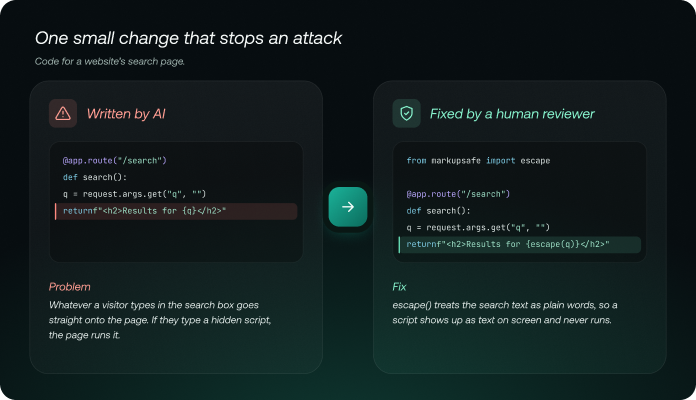
This is where AI code quality matters most. Veracode’s 2026 GenAI Code Security Report found that roughly 44% of AI code generation tasks introduced a known security flaw, barely changed from its first report, and models built for coding were no more secure than general-purpose ones. Cross-site scripting has been one of the weakest spots throughout its testing.
Cross-site scripting, or XSS, happens when a website displays what a user typed without cleaning it first, so a malicious visitor can slip in a script that runs in other people’s browsers.
How AI-Generated Code Adds to Technical Debt
Technical debt is the future cost of shortcuts taken today. It works like a credit card: borrowing feels free until the interest shows up as bugs and code nobody wants to touch.
When code costs almost nothing to produce, teams accept more of it, duplicated logic included. Months later, someone changes a feature and discovers it lives in six slightly different places.
Can AI Coding Tools Replace Software Developers?
The evidence so far points to a job that is changing shape, and research is still catching up with the tools. METR found that experienced developers took 19% longer with AI tools in early 2025, then reported in 2026 that they are probably faster with current tools, though it calls the newer data unreliable.
The more lasting lesson from that original trial is about perception. Developers expected AI to make them about 24% faster and still believed afterwards that it had helped, even though they were measurably slower. People are poor judges of how well AI is working for them, which is a good reason to keep someone checking the output.
What Human Oversight in Software Development Looks Like
Giving AI Coding Assistants Clear Instructions and Context
Many teams keep a context file, often called AGENTS.md, that briefs AI agents on how the project works. A 2026 study from ETH Zurich and LogicStar.ai found that files written automatically by AI made agents slightly less successful while raising costs by over 20%. Files written by the project’s own developers gave a modest boost of around 4%.
The researchers recommend keeping human-written instructions to the minimum the AI can’t work out alone. In practice, that means recording the unwritten rules, such as which module needs a second reviewer, and skipping what the documentation already covers.
Code Review Practices for AI-Generated Code
Code review means another developer reads a change before it becomes part of the product, usually through a pull request (a proposed change that teammates inspect and approve). Each risk above has a matching check:
New packages: confirm each one exists on the official registry and has a real history, pin exact versions in a lockfile, and run software composition analysis to scan dependencies for known problems.
Business logic: write or approve the tests from the actual requirement before reading the AI’s code.
Security: run a security scanner on every pull request, and check by hand wherever user input reaches a web page or a database query.
Architecture: search for existing helpers before accepting new ones.Size: keep AI changes small, since a 40-line change gets a real review and a 900-line one gets a skim.
Assumptions: ask the AI to list the assumptions it made, then verify the ones that touch money or user data.
If your team adopts only one of these, make it the business-logic check. Security scanners get better every year, but no tool will ever know that your finance team applies the discount after tax. That knowledge lives with people, so the tests that protect it should be written by people.
Keeping Humans Responsible for High-Risk Decisions
Authentication, payments, personal data and major architectural changes deserve a named human owner who reads every line. Developers largely agree: in the same Stack Overflow survey, only 6.6% said they would trust AI for important decisions. The more a mistake would cost, the less the AI should decide alone.
Choosing and Rolling Out AI Coding Tools in a Team
When you evaluate AI coding tools, look past the polished demo. The best ones flag a guess instead of presenting it as fact, and they fit your existing process so AI-written changes face the same reviews and automated checks as everything else.
Then measure real outcomes, such as bugs found after release, rather than how fast the team feels. Start with one team, learn what works, and expand from there.
Why Human Judgment Still Decides Software Quality
There’s an old saying in software that code is read far more often than it’s written. AI has made the writing almost free, so the reading now carries more weight than ever.
Here’s a small experiment for your next AI-assisted task. Before you read what the AI wrote, jot down in one sentence what the code must do and one thing it must never do. Then compare. The distance between your note and the AI-generated code is a fair measure of how much human judgment the task needed, and it’s usually more than the code’s confident tone suggests.
If that distance makes you curious about how human skill shapes the AI tools themselves, explore Deccan AI Experts and see that side of the work up close.