


Every time someone gets a reliable answer from an AI model, a human made that possible. That human probably never got credit for it.
They do not pause before answering a question about tax compliance, or flag that they might be wrong about a legal clause, or admit that the financial logic in their response has a gap. AI models answer. Clearly. Confidently. Every single time.
That confidence is by design.
The problem is not that AI models get things wrong. Every tool gets things wrong sometimes. The real problem is that AI models get things wrong in exactly the same tone they use when they get things right. And most people using them cannot tell the difference.
So the question worth asking is not "is this AI model smart?" It is: who decided what smart looks like for this model? Because someone did. And that someone might be you.
What actually goes into training an AI model
Before a model ever answers a question, thousands of people have already evaluated similar questions, corrected wrong answers, and decided what a good response looks like.
This is called AI training. And it is far more hands-on than it sounds.
When you work as an AI trainer or evaluator, your job is not to feed data into a machine. It is to bring judgment that the machine does not have. You read a prompt. You review what the AI said. You decide whether the answer is accurate, well-reasoned, and actually useful, or whether it just sounds that way.
That distinction is the whole job. And it is harder than it looks.
Why your domain expertise is the point
Here is what makes AI model training genuinely difficult.
The domains where AI is used most, such as law, finance, medicine, engineering, and education, are also the domains where reviewing an answer requires real expertise. You cannot catch a flawed legal interpretation without understanding law. You cannot spot a broken financial model without understanding finance.
A generalist can tell you if an answer sounds right. An expert can tell you if it actually is.
That is the difference that matters. And it is exactly why platforms like Deccan AI Experts exist, not to find people who can click through tasks quickly, but to find people who genuinely know their field and can apply that knowledge to evaluate AI with precision.
If you have spent years in a domain, you carry something a generalist reviewer does not. You know when an answer is technically plausible but practically wrong. You know when something will work in one context and quietly fail in another. That kind of judgment is what makes an AI model trustworthy, not just fluent.
More evaluations does not mean better AI
The AI industry assumed for a long time that more training data means better models. More examples, more evaluations, more volume.
This is only partially true.
A few hundred evaluations from genuinely expert reviewers can improve a model more meaningfully than thousands of low-quality ones. Because what the model internalises is not the number of examples. It is the quality of thinking behind each one.
This is why how you do the work matters as much as how much you do. When you explain what better reasoning looks like and why an answer falls short, that distinction shows up in how the model behaves afterward. Your evaluation does not disappear into a system. It shapes how the model responds to the next thousand people who ask a similar question.
What this work actually looks like in practice
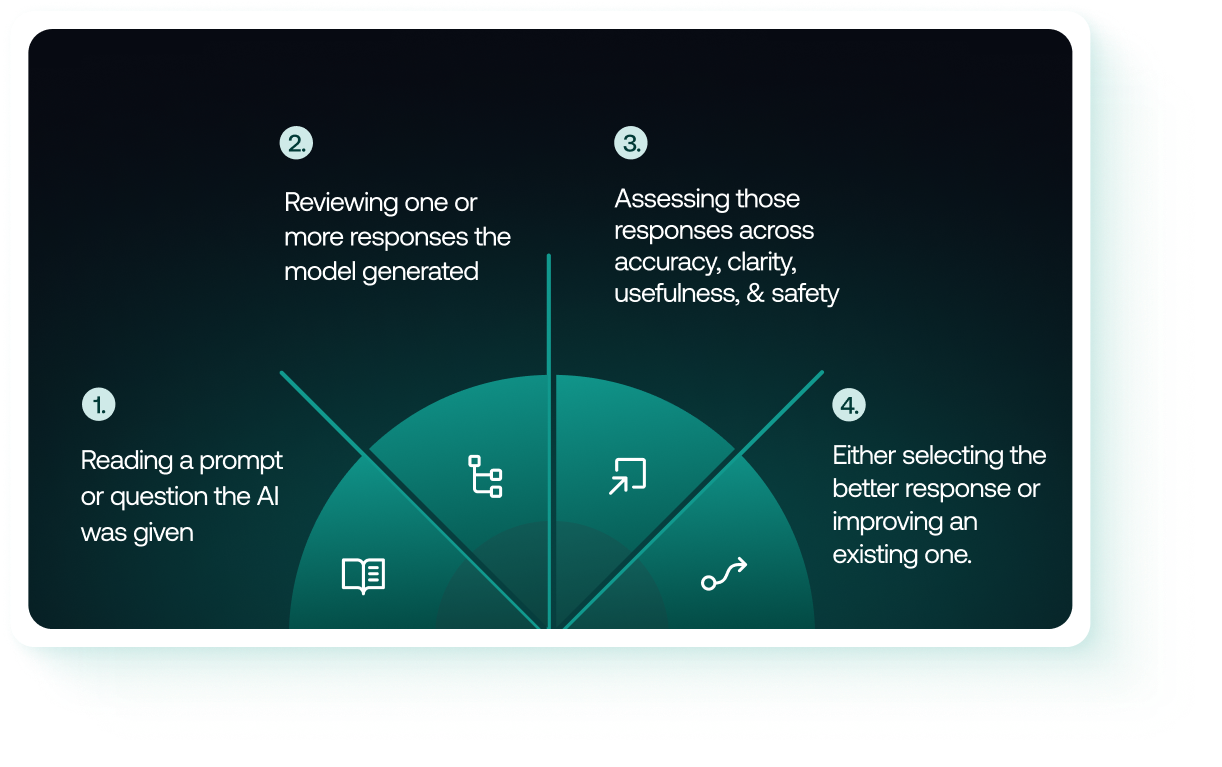
A typical AI training task involves:
- Reading a prompt or question the AI was given
- Reviewing one or more responses the model generated
- Assessing those responses across accuracy, clarity, usefulness, and safety
- Either selecting the better response, improving an existing one, or writing what a stronger answer would look like
Each task is a small decision. But those decisions add up. Every evaluation you make leaves a trace in how the model reasons, what it treats as acceptable, and where it cuts corners.
Every standard you hold becomes part of the model's default behaviour for every person who uses it afterward.
Why this work is worth taking seriously
The gap between an AI model people can rely on and one they cannot is not about which company built it or how much compute went into it.
It is about the quality of the humans who taught it what good looks like.
That is the work you are doing when you evaluate AI. Not a side task. Not data entry. You are making decisions that determine how a model behaves in the real world, for doctors, lawyers, engineers, students, and businesses, long after your evaluation is submitted.
That is worth understanding. And worth doing well.